
Toi Market & Second hand Goods - Nairobi, Kenya
Friendly locals with second hand goods at favorable prices!Toi Market Snapshot
Location
Hours
What You'll Find
Each shop has it’s own “theme” whether it be denim, shoes, casual shirts, belts, you name it. There’s so much treasure to be found here that I can’t really recommend anything specific. Just like any thrifting experience, it’s always an adventure!
Kenya – Toi Market Video
Kenya Flea Market Spree!
Today, we’re out in Nairobi, Kenya hustling at the flea markets, bargaining for ORIGINAL second hand stuff! I seriously just can’t believe how much second hand goods you can find here. From Nike to Converse, Levi’s to Carhartt, and everything in between!
We mostly spend our time at the Toi Market here in Nairobi, Kenya. But there are so many other markets around town where you can bargain for second hand goods too. So come along for the ride!
Everything to Know About the Toi Market in Nairobi, Kenya
How to Get to the Toi Market in Nairobi?
From the city center, you can easily take an Uber and they can take you directly there. Honestly, Uber is the main mode of transport.
I don’t even recall seeing any taxis here!

You could also catch bus number 8 from the Railway bus station or bus numbers 3 or 4 from Adam’s Arcade. If you have access to a bicycle it is a quick and easy bike ride from the city center. Just make your way to Ngong Road and you’ll be there before you know it.
Shopping at the Toi Market & Other Second Hand Markets
Located on the outskirts of one of Africa’s largest informal settlements, Kibera, or the Kibera slum, the Toi Market spans an impressive 6 acres and holds over 5,000 booths.
As mentioned, the Toi Market (as well as many others in Kenya) is full of second hand merchandise – at favorable prices. Most shops have a sort of “theme” to them, whether it is shoes, denim, casual shirts, belts, etc.
You can find ORIGINAL brand name clothing here and most items are usually priced the same (within each respective shop) regardless of brand name!
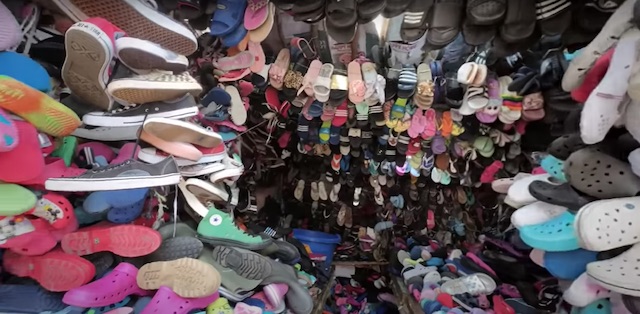
Mitumba (Second hand) Markets
Second hand markets are extremely popular in Kenya. With bales of “Mitumba” arriving from other countries for shopkeepers to buy then resell at their own stalls. These markets offer bargainers unique deals on just about everything you can imagine – items such as trinkets, small accessories, and appliances, electronics, shoes, swimsuits, jewelry, and toys.
Most popular are their secondhand clothing by name brands such as Prada, Nike, Puma, Birkenstock, you can also find great toys such as Barbie, high-quality electronics, or even furniture and vehicles!
The locals swear only about 10% of the goods are knock-offs, and they pride themselves on the quality of their products, and the price.
Bargaining at Kenya’s Second Hand Markets
Although incredibly cheap, most items are marked up almost triple what they are worth, so don’t be afraid to put those haggling to work to get the price you want.
You may even start the bargaining at 3/4 to 2/3 the listed price! Don’t worry, you’re not ripping anyone off either, vendors won’t go lower than they can afford so feel free to bargain till you get a price you can both agree on.
Where to Stay in Nairobi, Kenya?
When searching for a good place to stay in Nairobi, keep in mind the things you want to do and where they are located so you can find a place that’s conveniently located.
Places to Visit in Nairobi & Around Kenya
While visiting the markets is a must-see for a lot of us, it is by no means the only reason to come to Nairobi.
Safari! You can’t visit Africa without going on a safari! And Kenya is the original home of the Safari that may of us have come to know over the years. You can do one within the city, or go out into the countryside! The city one is actually a pretty cool experience as you can see the city skyline in the background while viewing the lions, giraffes, what have you.

Before heading off to see the lions, buffalo, and giraffe, you may want to make a stop into the David Sheldrick Wildlife Trust and visit the baby elephant orphans. Lovingly know as the “Elephant Orphanage” they find and take in abandoned baby elephants, and work towards reintroduction to the wild. They are happy to report a 100% success rate.
In the Lang’ata neighborhood, located southwest of the city center you will find The Giraffe Center, Bomas of Kenya, and the Uhuru Gardens.
At the Giraffe Center, their mission is the conservation of the incredibly endangered Rothschild Giraffe. Here they breed the animals and work tirelessly on reintroduction to the wild.
Bomas of Kenya is an activity center where you can come to watch daily performances of traditional dances and drumming of the tribes of Kenya. It also contains an open-air museum and a large theater.
The Westlands and Parklands Neighborhoods
Westlands and Parklands are the more upscale areas with plenty of shopping malls.
The Parklands neighborhood is just north of the business district and is a mix of commercial and residential homes. This area borders the Karura forest which provides many hiking trails and picnic areas.
The Westlands, technically a section of the parklands, is located close to the center of the city, offering visitors tons of shops, nightclubs, restaurants, bars, and museums to meander through.
And when you are finished exploring Nairobi and the interior wildlife areas, you may also want to make a stop out at the coast to enjoy some amazing beaches and relaxation!
Food in Nairobi & Kenya
With the mass amounts of shopping, or searching, you’ll be doing at the Mitumba markets, you’re bound to get hungry! Nairobi, and Kenya in general, have some amazing and unique local and foreign cuisines.
My personal favorite – Smokies! There are a bunch of smokie shops on the streets here with many varieties of sauces and toppings!
For more details and to see for yourself, check out my bro, Myles, from Tasetbud Takeover as he goes on a mission to sample Smokies and even try to create a custom version!
Kenyan food is diverse and delicious. With over 40 different ethnic cultures to be influenced by, you can find inspired foods from India and Mexico. If you get hungry mid-stride, indulge in some of the local street food favorites.
You can find delicious meals for any time of day, including Mahamri, or a deep-fried donut, or Mshikaki, grilled kebabs, at an affordable price. This is a great way to experience the food culture and get a taste for the country, even if you are traveling on a tight budget.
Looking for something a little more formal or have a bit more money to spend?
Nairobi, the country’s capital provides everything from traditional cuisine in beautiful settings to 5-star Japanese restaurants. Some must try foods while you are in Kenya include, Ugali, cornflour mixed with boiling water into a dough. Sakura Wiki, Collard Greens. Nyama Choma, Roasted meat, goat, beef, chicken, or fish. Kaimati, Kenyan dumplings.
Kachumbri, Mix of chili peppers, onions, and tomatoes. And Mutura, or Kenyan sausage, goat intestine stuffed with ground meat, goat’s blood, ginger, garlic, coriander, and piri piri chilis.
About the Toi Market
The Toi Market is Nairobi’s second largest Mitumba (second hand) market. It began around 1983 by Nubians that were settled in the area by the British after World War I. The original market was located on a small plot of land originally meant for a government building.
Those who were rejected due to not enough room or payment, started what became the Toi Market next door on a larger plot of land. The open-air market now sits on roughly 6 acres, and has over 5,000 shops. These booths are traditionally made from scraps of wood, rusted doors, and plastic or polyurethane roofs.

The Toi Market has seen some ups and downs over the years. Incurring damages from post-election violence in 2008, a devastating fire burning down approximately 2,000 booths, and then COVID-19 stopping all of the markets temporarily.
Today though, life goes on and so does Mitumba. There are about a dozen Mitumba markets in Nairobi, Kenya, some of the most notable are: Gikomba, the largest, Ngara, and Muthurwa.
Introduction to Kenya
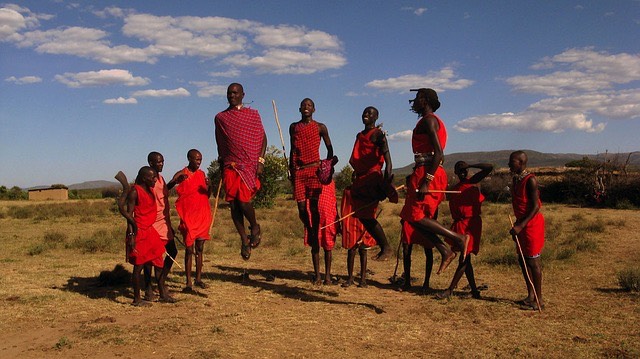
The history of this beautiful and diverse country is old and quite fascinating. The oldest fossil in the area gives evidence to a giant crocodile, 200 plus million years old. The first primates appear around 20 million years ago. Around 2,000 BCE, Cushitic-speaking peoples move to Kenya from North Africa. By the 1st century AD, Arab traders could be found in the area and by the 8th century, Persians and Arabs began to settle here.
Bantu and Nilotic-speaking people started moving here by the 1st millennium AD, and this community began to flourish. During this time shipbuilding became the main economy along the coast and by the 15th century AD, the major city port of Mombasa was being written about by travelers from all over the world.
History of Trade & Producing Goods in Kenya
The country stayed under British rule until the Mau Mau Rebellion which placed Kenya in a State of Emergency from 1952 to 1959. This resulted in the countries first elections, in which Africans were elected to legislative council for the first time. The Kenyan African National Union would take charge until a constitution was formed and independence was granted to the Republic of Kenya on December 12, 1963.
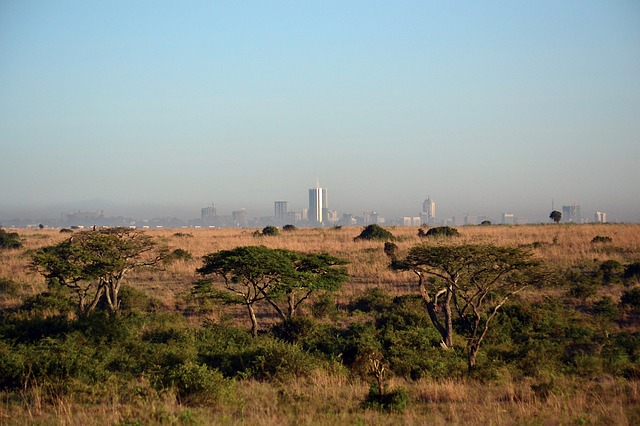
Kenya’s economy relies largely on the imports and exports of the country, and is a major player in the Global Trade game. Its exports include, tea, coffee, petroleum products, and horticulture products.
Imports include transportation and machinery equipment, petroleum products, iron, steel, and secondhand clothing or “Mitumba” (Swahili for bundle). Kenya imports roughly 100,000 tons of secondhand clothing every year. It not only provides revenue for the government through import taxes and tariffs, but it creates tens of thousands of jobs and provides residents with well-made affordable clothing options.
It is said that about 65,000 people work in the largest Mitumba Market in Nairobi (the county’s capital), Gikomba. Gikomba brings in approximately $1.1 million per month! The expansive choices of clothing, shoes, and accessories from major brands have created a unique lifestyle and culture in the area.
In the 1990s economic liberation programs began to be put in place. This, coupled with local goods being subsidized by the government, and charging prices that were too high for the general consumer, caused many local textile factories to close.
Due to COVID-19 precautions, secondhand clothing was banned for a time (although it’s back up and running now). This pause gave local clothing companies a rare opportunity to change the market in Kenya, but they will have to cater to the masses if they want to get a footing in this economy.